
At Least We Had Rice
Scenes from a Third Culture childhood
Text Nikki Bonsol
From Hella Pinay 03: The Culture Issue - Spring/Summer 2022.
“A [Third Culture Kid] is a person who has grown up in many cultures all at once — and so lived in the cracks between them.”
– Pico Iyer
You can tell how important something is to a culture by how many words the people have for it. Filipinos, for instance, have innumerable words for rice…
Palay: unmilled rice
Bigas: milled rice
Kanin: cooked rice
Bahaw: leftover rice
Pinipig: toasted rice flakes
Tutong: burnt rice
Lugaw: rice porridge
Sinangag: fried rice
And how many words are there to describe what it means to be Filipino?
There are words related to gender identity, and countless ways to describe a mixed heritage. There’s a word for Filipinos in America, and of course the words that identify which specific island/region our people are from.
I was born in Morocco, and raised in Canada, Malawi, Kazakhstan and Mozambique before immigrating to the Bay Area at 16. I am Filipina and Filipinx. I am Tagalog and Visayan. I am pinay, but not quite Filipina-American. I am… missing some words.
In a world that likes to ask, Where are you from?, what do you call a Filipino who calls multiple countries home? What do you call a Filipino who is always secretly homesick, no matter where they are in the world?
Is there a word for that?
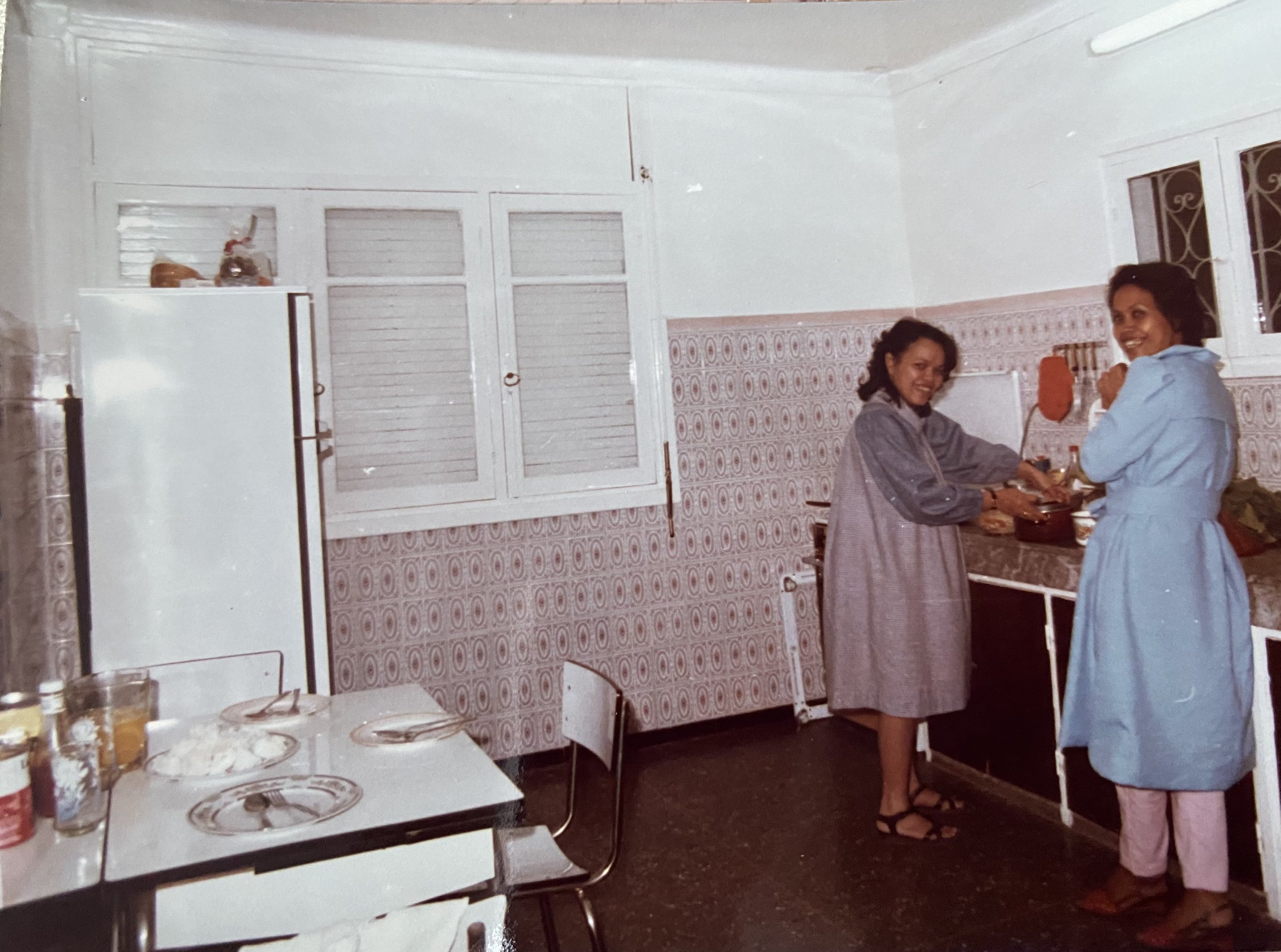
Mom and Auntie Mila in their kitchen in Rabat. A plate of rice on the table.
Bigas
Rabat, Morocco | 1984
It’s raining when Joy and Nilo Bonsol land at Rabat–Salé Airport, and they walk straight off the plane into a soup of jet fuel and wet tarmac. Already this is different from Manila, where they use jet bridges to enter and exit planes from air-conditioned boarding areas. But a little weather does not discourage my parents.
My father was recruited from the Philippines to work as a Computer Systems Manager for an American aid organization in Rabat. My mother is three months pregnant with me. Mom’s Ate Mila would arrive in a few weeks to help take care of me. Like thousands of other Filipinos, they left their homeland to find a better future. To help them prepare for the trip, Dad’s employer had given them an extensive packing list of items that might be difficult to find in Morocco.
How would you pack for a new life? Would you want to leave everything behind, or bring all your comforts with you? My parents didn’t have much in terms of household effects, so they shipped only a few essentials: an ironing board, an iron, a rice cooker — and a 25kg bag of rice.
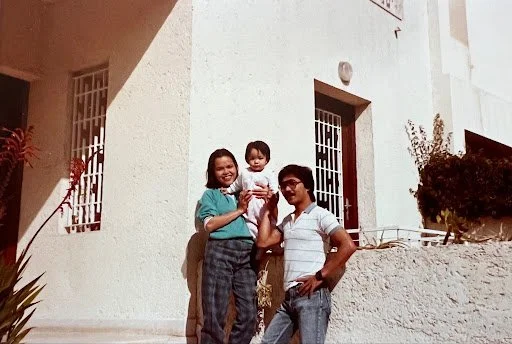
Mom, Dad, and Baby Nikbo outside our home in Rabat.
I imagine what those years in Rabat were like for my elders. Going to events at the Philippine Consulate to make friends. Exploring North African cuisine, and figuring out how to make Filipino food with new ingredients. Giving birth in a hospital where everyone only speaks French. Raising me and my sibling, Erin, far away from the rest of our family.
When I ask my mother what it was like, she talks about it without drama. “No matter what was different, or what was hard,” she says, “at least we had rice.”
Kanin
Lilongwe, Malawi | 1990
When did you first realize you were Filipino? I was six.
My family had just moved to Lilongwe from Calgary, and Erin and I are over at our British-American friend Hannah’s house. Her mom calls us in for lunch and presents us with PB&J’s.
Weird, I think. Where’s the rice? This must just be an appetizer…
We finish the plate, and I wait for a main course to appear, but… that’s it.
Hannah pulls us back outside. I’m still hungry. She and Erin start making bows and arrows out of twigs while I quietly try to make sense of a world where some people believe a sandwich is a meal.
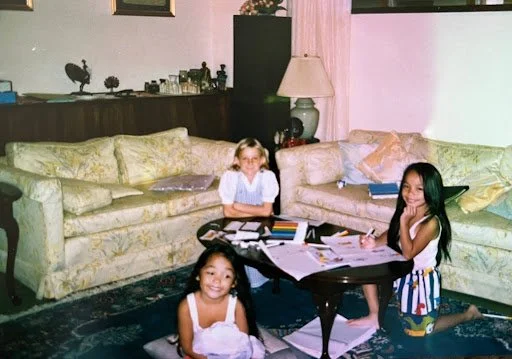
In our living room in Malawi. From left to right: My younger sibling, Erin. Hannah, in her school uniform. Me. I do not remember those sofas at all...
Tutong
The Philippines | 1996
It’s mosquito hour when we arrive in Rosario. Lamok, I say to myself. I’m practicing new Tagalog words. My parents raised us solely on English “so we wouldn’t have an accent.”
I hop out of the car expecting humidity and exhaust, but the air in Batangas is fresh. The land is so lush that I half-expect to see those tiny Jurassic Park dinosaurs dart across the road.
A flock of Bonsols appear in the street — aunts, uncles, and cousins from my dad’s side — hugging, kissing, laughing, and slapping at each other. Erin and I cling to Mom’s shorts while shyly touching our elders’ warm hands to our foreheads.
“Are you hungry? Come, kumain ka na.” We are swept inside.
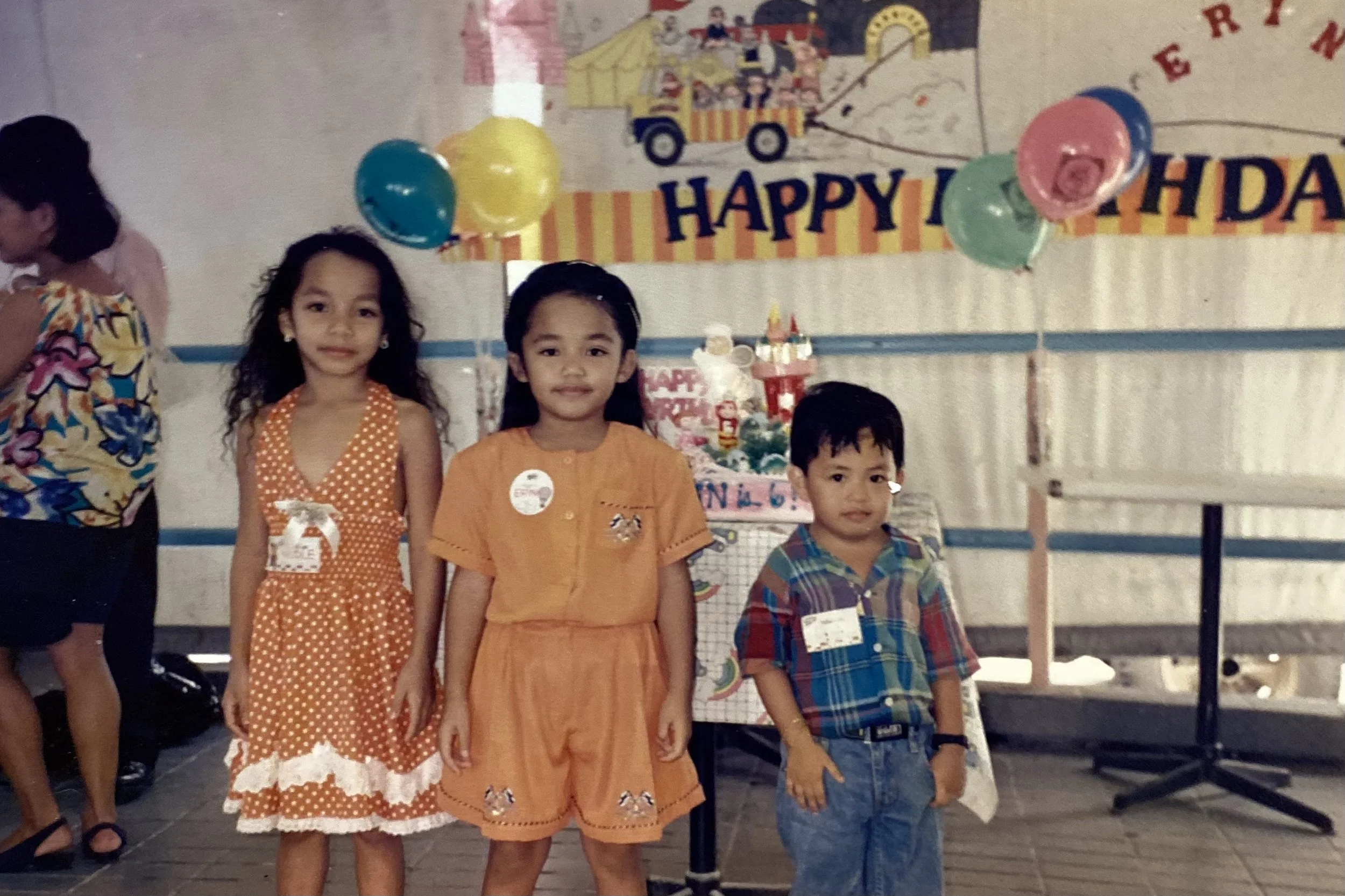
Celebrating Erin's birthday at Jollibee while visiting Manila. Left to right: Me and Erin in color-coordinated fits. Our cousin DJ.
I usually feel at home in the clamor of a big, fat, Filipino meal. Back in Lilongwe, my parents hosted Philippine Independence Day parties, inviting titas, titos, and guests from all over Malawi to potluck and feast. We passed around plates and napkins and lined up at the buffet table, kids first. Someone said a prayer. There was sweet, salty meat and garlic shrimp with their heads still on. Even the adults talked with their mouths full. When it was time to send our guests home with tin foil-wrapped baon, I felt full, in all senses of the word.
But here in Rosario… are there too many empty bottles of San Mig on the window sill?
I’m using my rice to soak up the last bits of sauce on my plate when Tito Leo asks me a question in Tagalog. My cheeks flush and I look down at my greasy hands when Dad says I can’t understand. Tito slurs a little as he says something else in Taglish. I hear the word “snob” and an accusatory tone. The whole room laughs.
I try to distract myself from the shame tickling my tear ducts by scooping another ball of rice into my mouth. It’s bitter, slightly burnt from the bottom of the pot. Erin looks at me with a wrinkle between their little eyebrows.
I hate it here.
Bahaw
Almaty, Kazakhstan | 1998
Praise the lord, it’s finally happening: my best friend is Asian! Japanese, specifically. And even though our peoples were enemies during World War II (a fact that her mom apologized for when I first came over), we’re inseparable. Erin left to go to boarding school in the Philippines, so I’m now the only Filipino kid at school. An Asian best friend is a kind of salvation.
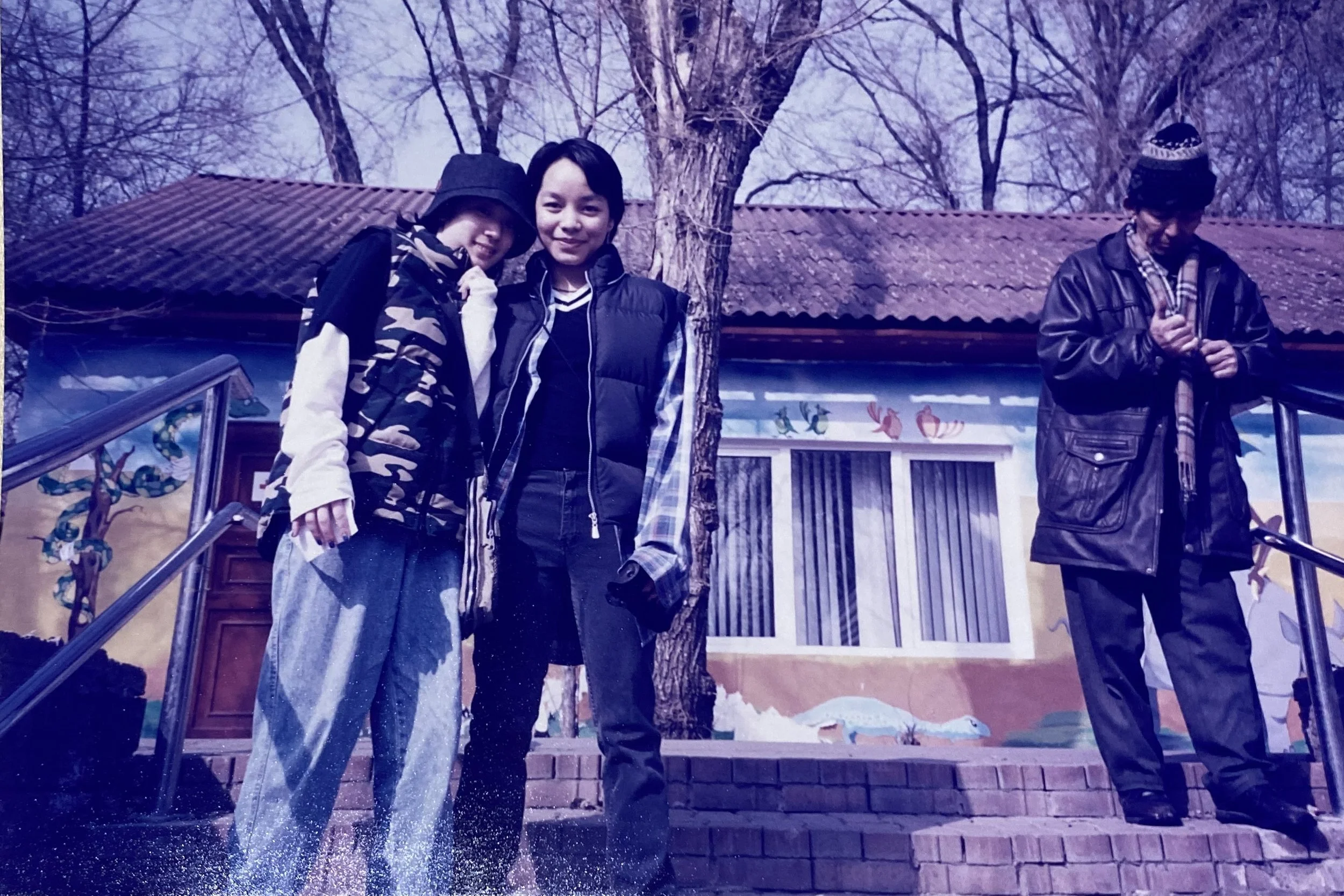
Me and my bestie, Asami, in a park in Almaty.
Things we have in common:
a specific preference for room temperature rice over hot rice
moms who are angered by an A-
oldest child syndrome
the ability to switch seamlessly between American and English accents because we both went to British schools
a tendency to be mistaken for boys when we go snowboarding
an infatuation with JTT
bubbly handwriting
Sinangag
Bay Area, California | 2001
How (not) to make Filipino friends at college: A recipe.
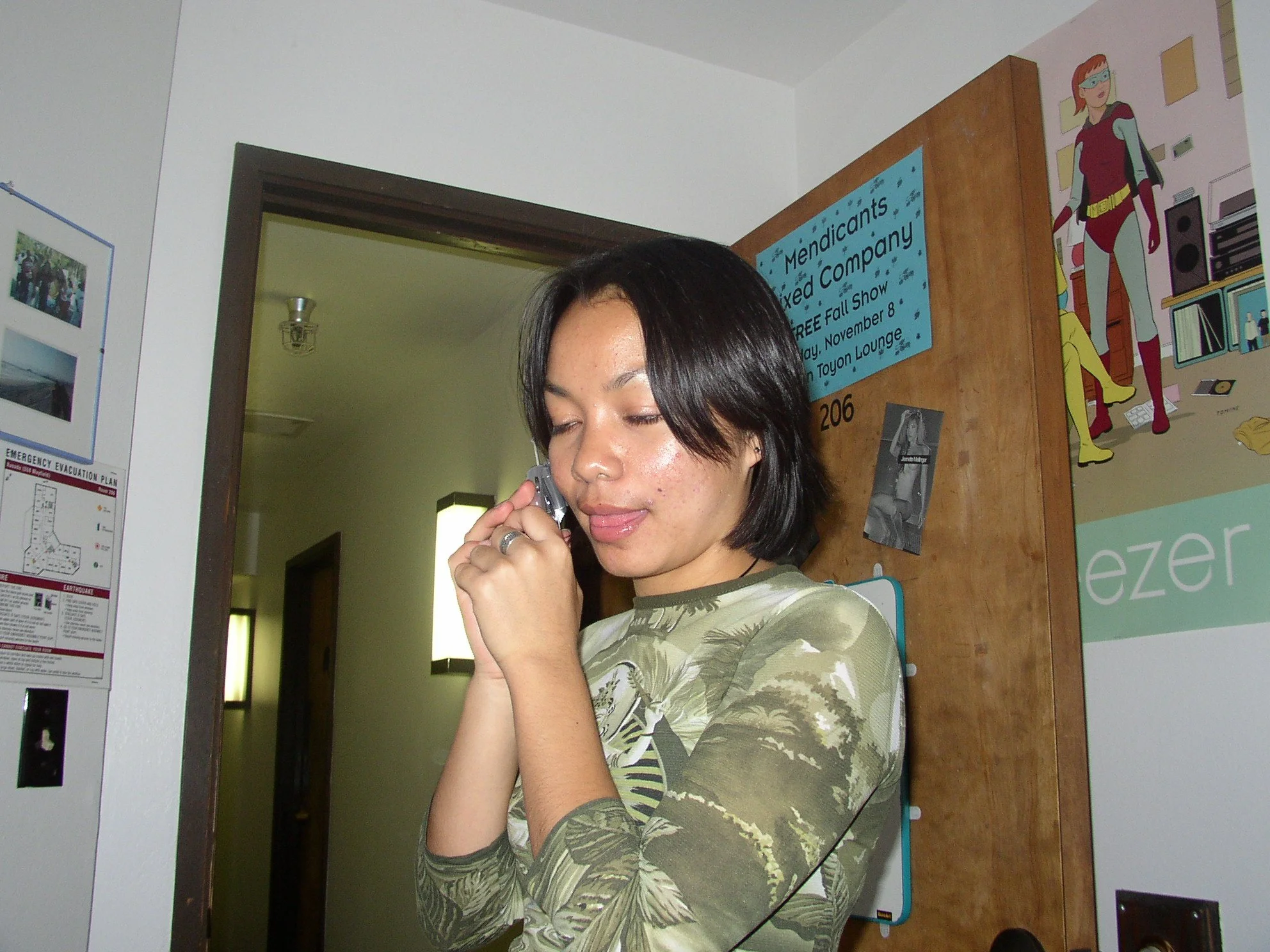
Sophomore year. Lol tiny cellphone.
Start with a big portion of leftover “eagerness to make Filipino friends.” It’s best if at least 1 – 2 days old, so the grains are dry and ready to take on new flavors. If your eagerness comes from 16 years of not knowing any other Filipino kids besides your sibling — even better.
Finely chop your answers to the question, “Where are you from?” They must be easily digestible. You might be tempted to say, “Well, I was born in Morocco… but I have a Philippine passport. But I’ve never lived in the Philippines… I mostly grew up in Malawi, but I moved here from Kazakhstan…” Stop. You are too much. Keep it tight and tasty.
Toss everything in the pan with some “I’m-not-American-enough” inferiority complex until any foreign flavors start to mellow and blend in. But be careful that you don’t accidentally season with an “I’m-not-American” superiority complex. This is not as palatable a flavor if you’re trying to get folks to like you.
Taste test: What’s missing? Download the Best of SWV from LimeWire in an attempt to fill in the gaps of your U.S. pop culture knowledge.
Serve, and don’t forget the garnish. Bike to Macy’s for something un-fobby from the sales rack. Consider investing in face-framing highlights, but settle for a new lip gloss because that’s in your budget.
Note: This is a fickle recipe. Be vigilant about the details. If you mess this up, even MSG won’t save you.
Palay
Somewhere between Oakland and Calgary | Present day
I always miss my sibling the most on the day I leave them. I drag my suitcase out Erin’s front door into the snow, and they swing it into the truck. Our partners are already sitting in the cab, ready to leave for the airport, but I don’t want to rush. I give them a long hug on the sidewalk. It really hurts.
Half an hour later, I’m sitting at the gate, waiting for my flight and trying not to cry. This is a familiar grieving place for me. I regret not making the choice to immigrate to Canada to be close to my family… but was it really a choice? I had such a singular focus to come to the U.S. when I was a teen, bewitched by the American Dream. My regret shifts to an abstract anger at colonization. This, too, is familiar.
I feel ready to break, but I know this will pass. I know that as I get farther away from them in time and space, I’ll forget how Erin feels like my only true home. How, as someone who grew up right beside me, they might be the one person in this world that really understands who I am.
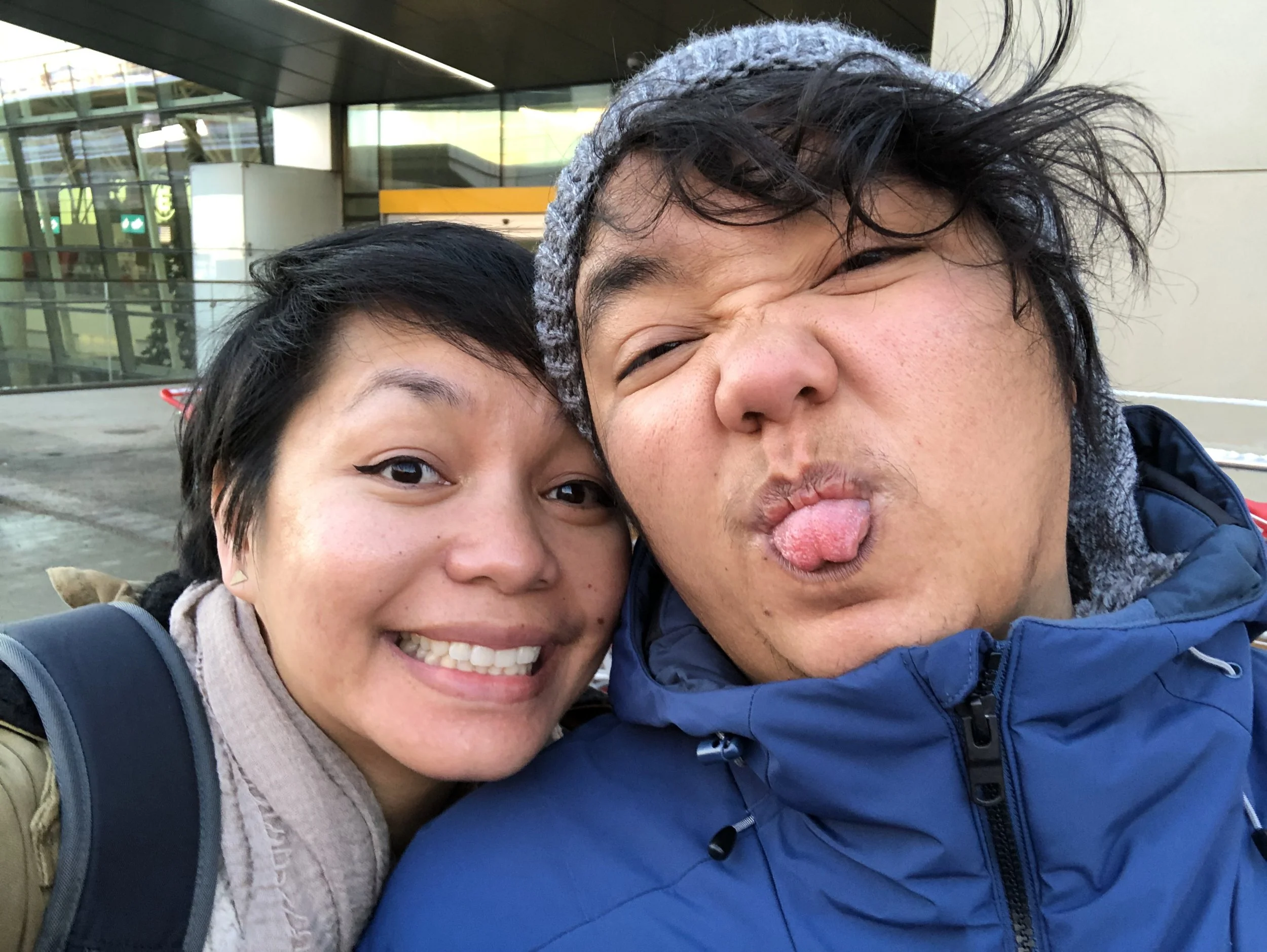
Departure selfie. We take one every time one of us drops the other off at an airport.
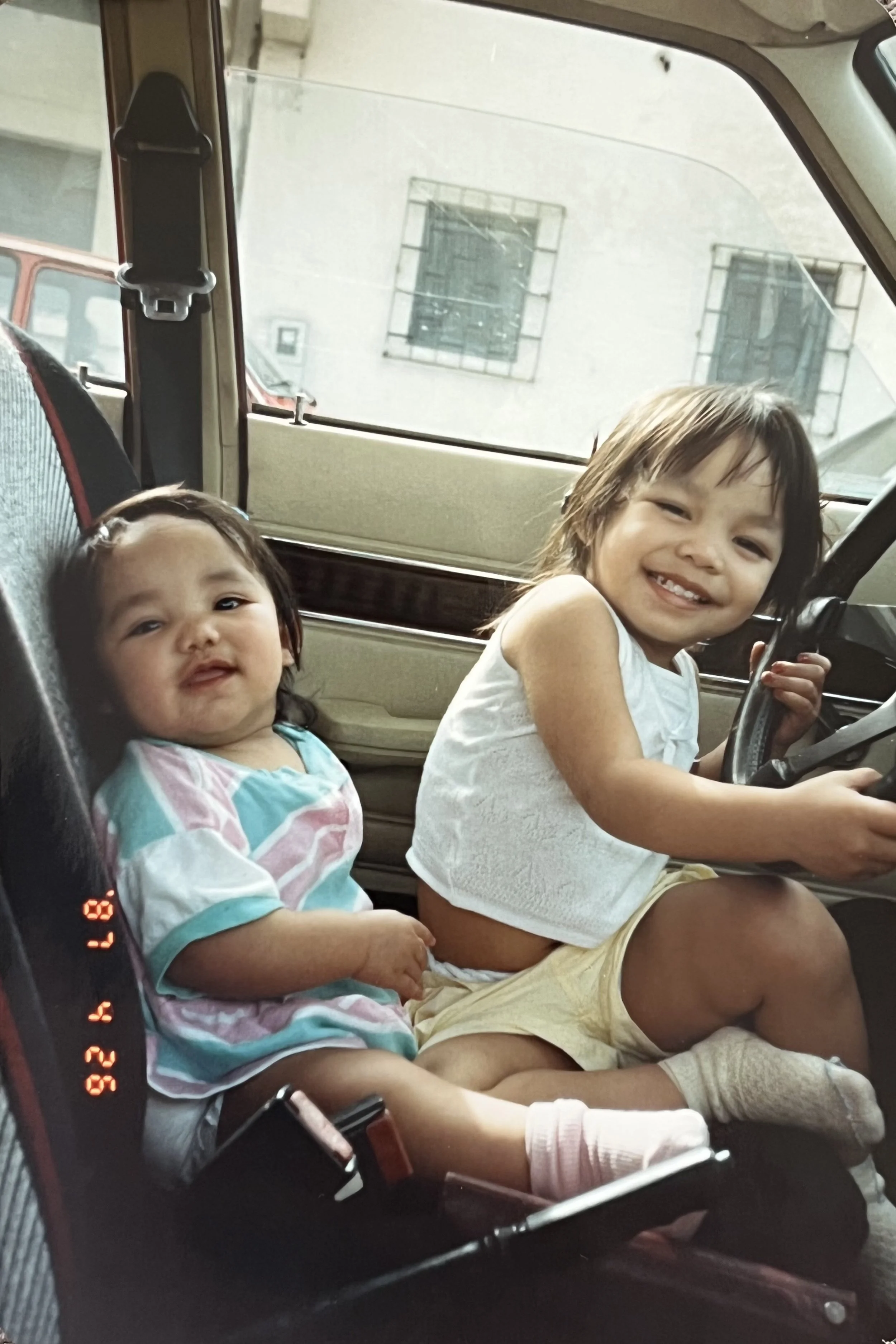
A coupla day ones.
I’m on the plane and my face is dry. I feel the heartache receding. I picture my emotional body turning into a grain of rice, with coils of loss wound tightly inside. My raw edges start to smooth and harden. Soon all will be hidden under a glossy husk.
Is this how others survive in diaspora? I marvel at how our bodies can withstand such distance from home.
From Hella Pinay 03: The Culture Issue - Spring/Summer 2022.


Growing up Pinay, self-love and acceptance are ever growing and transforming