
Mood Indigo
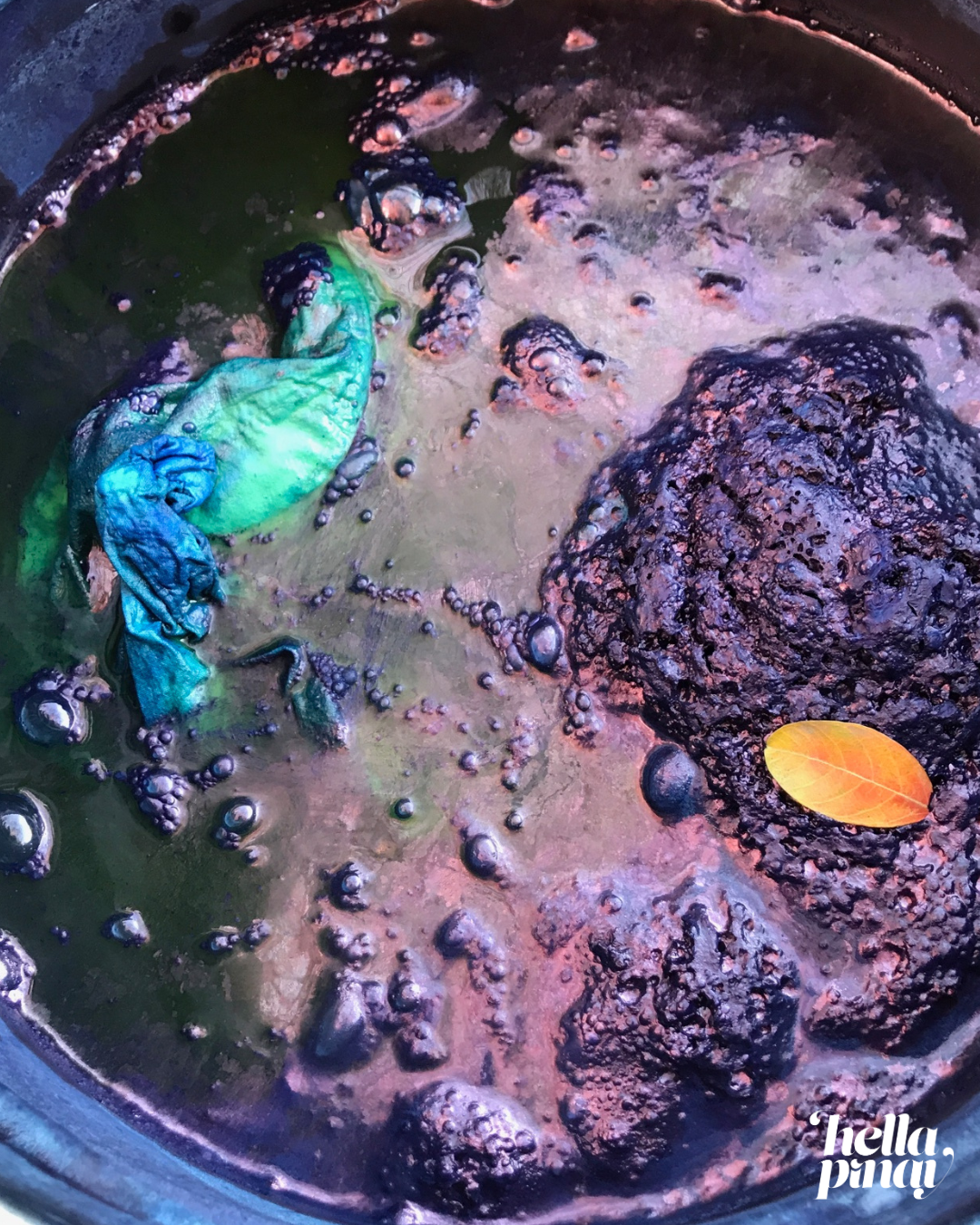
Indigo dye. Photo courtesy of the author.
Transmitting the frequency of my ancestors through the poetry of plants
Text Jamie Pesquiza Cardenas
Photography Kim Acebo Arteche
From Hella Pinay 03: The Culture Issue - Spring/Summer 2022.
My name is Jamie Pesquiza Cardenas. My middle name translates to “research,” and my last name means “blue.” I am the daughter of Jaime Galinato Cardenas and Angelita Pesquiza Cardenas. Although I have never stepped foot on my parent’s home soil, I know where I come from because of them. They grew up as neighbors in a town called Santa, in Ilocos Sur –– the same place Gabriela Silang is from, the same place my grandmother is from. Mama Mary would recall stories of her birthplace. She always took the time to remind us where we come from. She sounded like fire.
I am a walking altar to all those I love.
My journey started about 6 years ago. There was an urgent need to try something different for managing my health. It first expressed itself as my love of cooking; any way I can keep my hands busy with the end result being something tasty and a treat to my senses –– I’m all in.
In the world, and often even in my own body, I did not feel safe. Grief can feel dizzying, but inside the small magical world of my kitchen I gave myself permission to explore. To play. To trust myself and my decisions. So when I fell ill, exploring plant medicine felt very similar to learning about the spices of life. It allowed me to engage all of my senses despite feeling like I was losing control over my own body. I didn’t know it yet, but this was the pathway in which I learned that what we make…and who we are, is medicine.
When people ask me where I learned how to make medicine, it’s hard to explain but: I learned because I am my grandmother’s granddaughter. My first taste of My Mama Mary’s medicine was in the way she would breathe us in as she kissed our faces or in the Chicken Tinola with Marunggay she lovingly made us. Equal parts science plus love.
My uncle mentioned to me that my grandmother was a weaver of Abel Iloko and would sell her Inabel punases (woven hand towels) and take her earnings and purchase one chicken and feed the whole village the same Tinola with Marunggay. It was the same Marunggay that she fed to my grandfather, Papa Ricky. She explained to me that she believed it was Marunggay that bought us all a little more time Earthside with him.
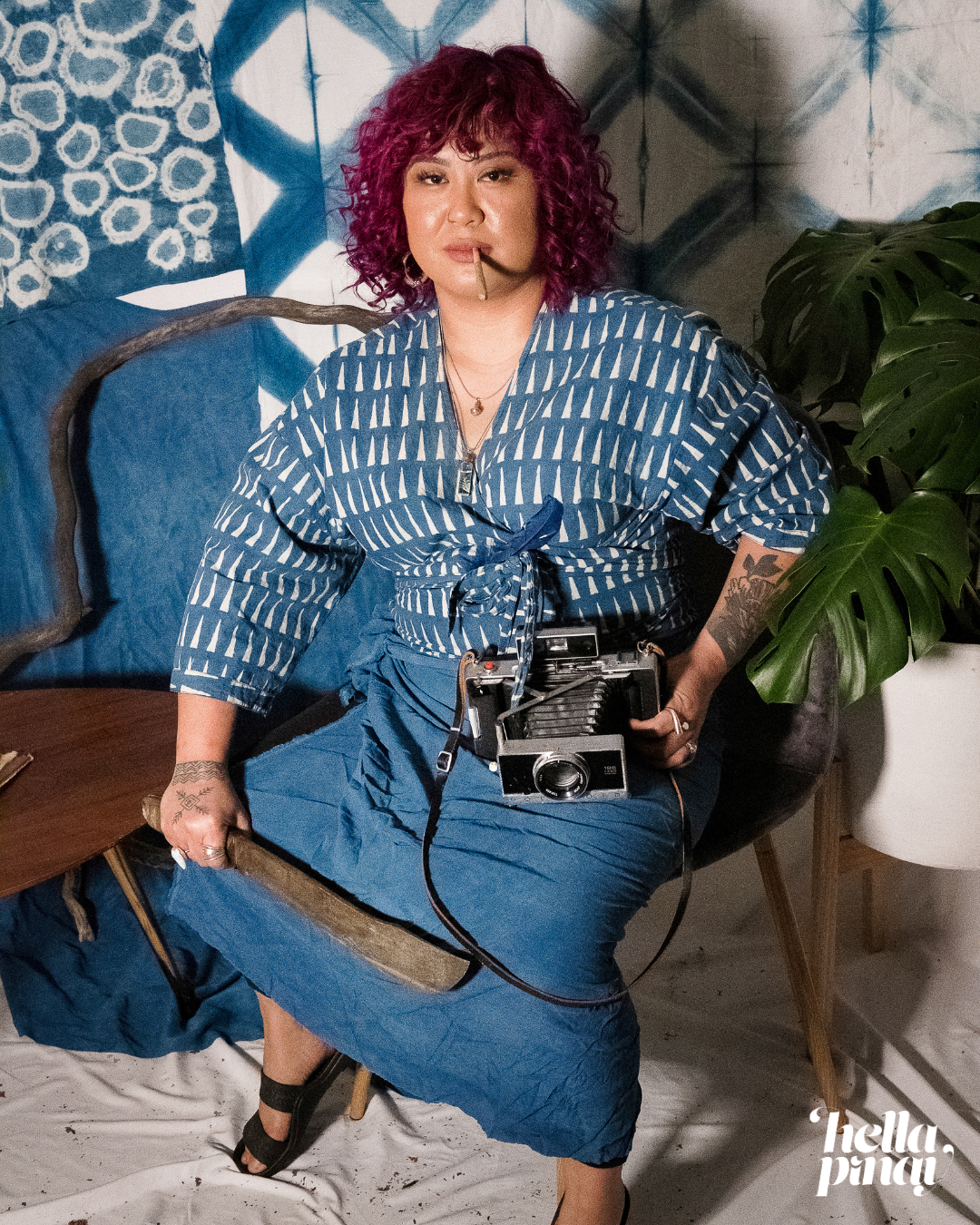
The author in the Hella Pinay studio with her hand-dyed indigo textiles. Photography Kim Acebo Arteche.
I know Mama Mary –– just like Mama Marunggay –– is what we would call a Mother Tree. Mother Trees communicate with others and share resources through a fungal network called the mycelium. It connects the Mother Tree and its surrounding trees, allowing her to communicate and share nourishment with her community. The visual of my ancestors having a web of support is something that really brings me joy. I know colonization tried to rob us of this and perhaps this is exactly what we are trying to revive. To re-member and return to the community care and radical love of our ancestors. Take care of each other. Make sure there’s enough to eat for everyone. Speak the names of your ancestors or what Mama Mary called, “having salt;” this translates to “show love and care for one another.”
It is through the Marunggay plant that I learned that my connection to plants spans beyond this realm. It is my connection to my ancestors. It’s like they are still in the room when I work with this plant and especially when I cook her Tinola. It’s palpable as I wash and carefully strip off the delicate leaves. I can feel them with me.
At the beginning of the Great Pause/Pandemic times, I felt the urgency of needing to create and felt so drawn to a plant named Indigo. It was always on my bucket list of things to learn before I die. It felt like death was all around me so I took this new art on like an obsession. It’s in my nature. Much like the pull to look at the deep blue ocean or at the bright blue sky, there is a connection.
There is a deep yearning I feel from being Pinay. You can hear it in our music. I think it’s why Filipinas are so amazing at singing because we can really express our emotions. I think the color blue captures this feeling. I love that Indigo is a plant, a color and a feeling all at the same time. In addition to finding out the true meaning of my family names, I also discovered that Manila translates to “Where the Indigo Grows.” I do not believe in coincidences.
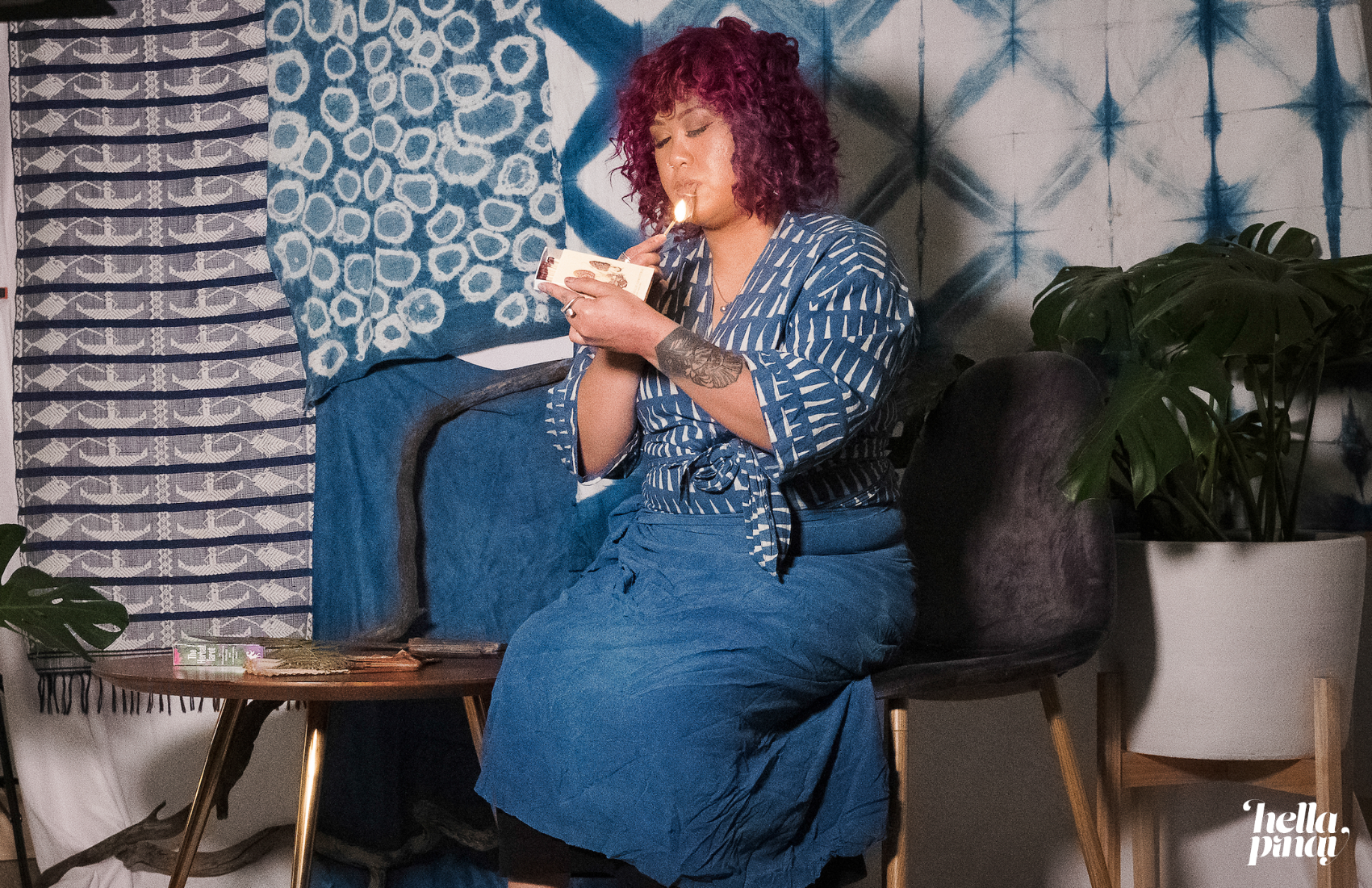
The author in the Hella Pinay studio with her hand-dyed indigo textiles. Photography Kim Acebo Arteche.
I have so much gratitude for plants. They have been like a key for me, unlocking parts of my family history and parts of myself. It was the magic of plants that brought me this beautiful community. I now belong to a weaving circle called Astig Weavers led by San Francisco Manang, Rachel Lozada. I never understood the power of coming together in circle with one another quite like I do now because I am in the company of incredible, powerful and creative Pinays. Maybe it’s because we all have the same wounds with no history together, but I learned that being in relation with them taught me how powerful it is to come together and love despite it all. Love like this has a ripple effect. We feel it the most in our nervous systems. The moment the body feels met, seen, heard in its fullness –– in this safety and attunement, the nervous system begins to soften its defenses and walls. This is where real healing truly happens. It's been this combo of the spirits of plants, of my ancestors and of my kapwa that are the true medicines of my life.
Much like in whole plant medicine, I’ve learned that we must embrace the full spectrum of being. Each part plays a role in our healing. We are complex, and so are our emotions and experiences. It's because of the magic of plants and the language I learned from them, that I have realized my ancestors’ wildest dream is actually to rest. Through our Endocannabinoid System, we hold a lock and key-like mechanism to receive plant medicine. Regulating our nervous system and repairing the trauma we’ve experienced is called Poly Vagal Theory, something I learned about in therapy this past year. The vagus nerve is the only nerve in our body that we can control. This nerve is the biggest component of our parasympathetic nervous system, which balances our fright, flight and fight responses. I’m thankful for tough and tender mental health practitioners like Dr Rona Magnilan of Stella Nova who are knowledge bearers in our community who are giving us the language of what it really looks like to heal.
Humans are 30% fungal mass, like the mycelium network. And the first Mother Tree I have ever known –– my Mama Mary –– taught me that we are all connected and we must take care of each other. Inside of us exist the same roots… this mycelium that lives in the earth, lives inside of us. This is what kapwa really means. This is what it looks like when we say healing happens in community.
Perhaps I survive because of you and you survive because of me. Sometimes it can feel like those of us in the diaspora are floating in the deep dark waters. When I feel lost and grief feels like it's too much, I like to imagine that the deep blue is also a plant named Tayum, a beautiful visual gifted to me by my dear friend Flex. Now when I look out into blue waters, I see a web of beautiful brown faces — the faces of kapwa. This gives me hope because I see just how connected we really are. We may be in the deep waters together but I feel like we’re equipped to give each other flotation devices. We will be okay because we have each other.
I’m really thankful for the medicine that is who and what we are.
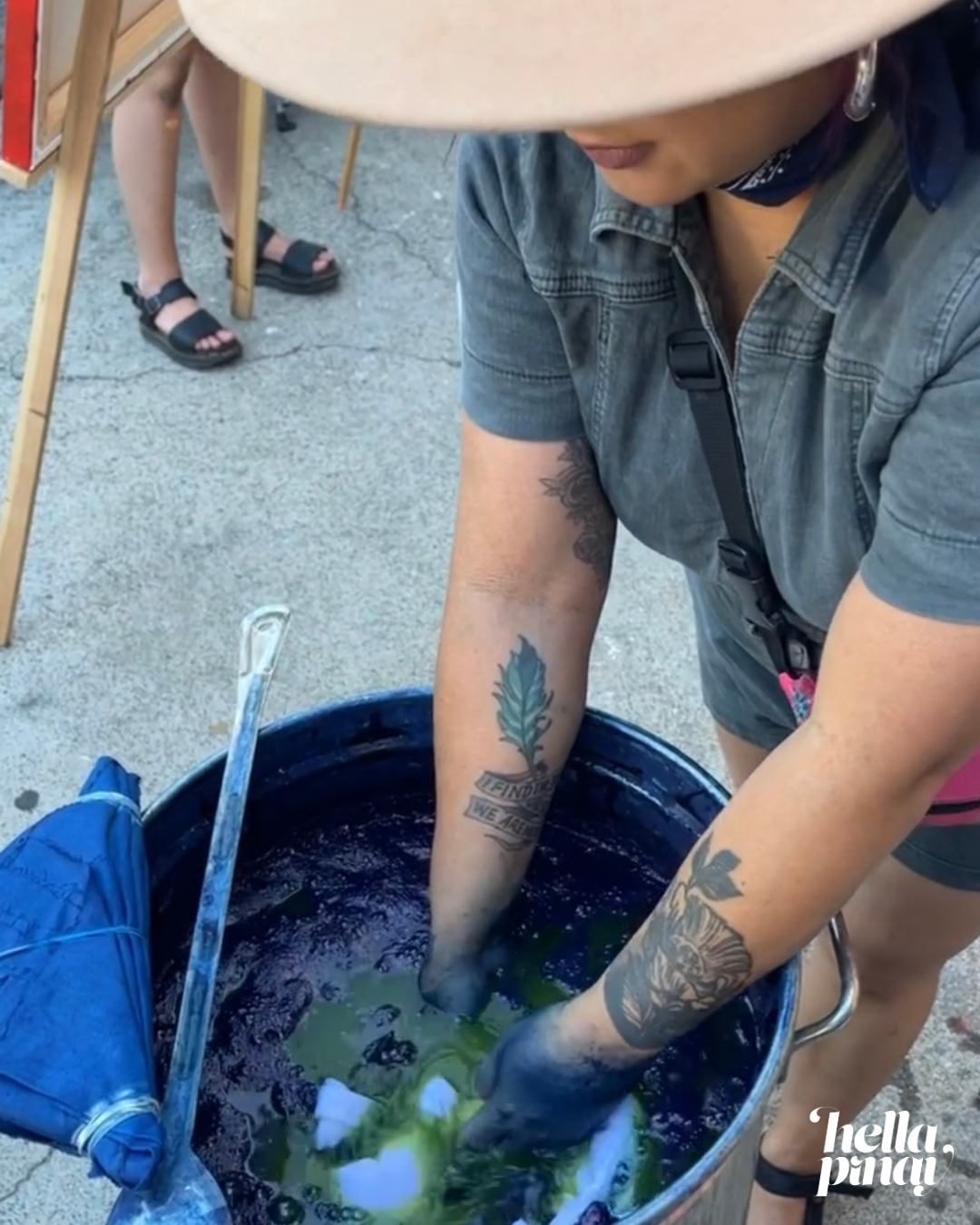
Jamie Pesquiza Cardenas working with indigo dye. Photo courtesy of the author.
Finding Home in your Body: Making Your Own Grounding Balm
Tools
Large Glass or Pyrex™ Vessel
Large Pot
Jar(s) for Finished Balm
Jar(s) for Infused Oils
Hot Plate or Stove
Strainer
Stirring Rods
Scale
Thermometer
Hard Oils / Waxes
40% Coconut Oil
20% Raw Beeswax (for a vegan balm, you can use Kokum Butter instead of Beeswax)
Infused Oils/ Liquid Oils
10% Guava Leaf Infused Grapeseed Oil
10% Olive Oil (or any neutral oil)
Essential and Other Oils
5-10% Ampalaya (Bitter Melon) Oil
5-10% Guava Seed Oil
Lavender Essential Oil
Lemongrass Essential Oil
Eucalyptus Essential Oil
Other
1-1.5% Menthol (optional)
Instructions
Combine ingredients (excluding the menthol and essential oils) in a large glass/pyrex™ vessel, and place into a pot of water, making sure no water spills into the vessel. (You may also use a double boiler for this.) On a hot plate or stove, melt at medium, bringing to a temperature of 150°-165°.
In a separate vessel, using a pot of water, or double boiler, melt the menthol at medium.
Remove melted ingredients from the heat and combine the oils/waxes, the menthol and essential oils. Stir until all ingredients are incorporated completely.
Pour balm mixture into jar(s) for storage/use. Cover with a paper towel and let it sit overnight to cure. (Do not put the lid(s) on until the balm is completely cured.
This formula is both for grounding and protection. Each of the ingredients are included as a way to connect back to our ancestors and our traditional medicines.
Use balm to come back to your body when you feel disconnected to yourself and your senses. Rub a little behind your ears to relieve tension. Use in a grounding ritual to return back to your breath. Check in and scan your body. Breathe in the aroma.
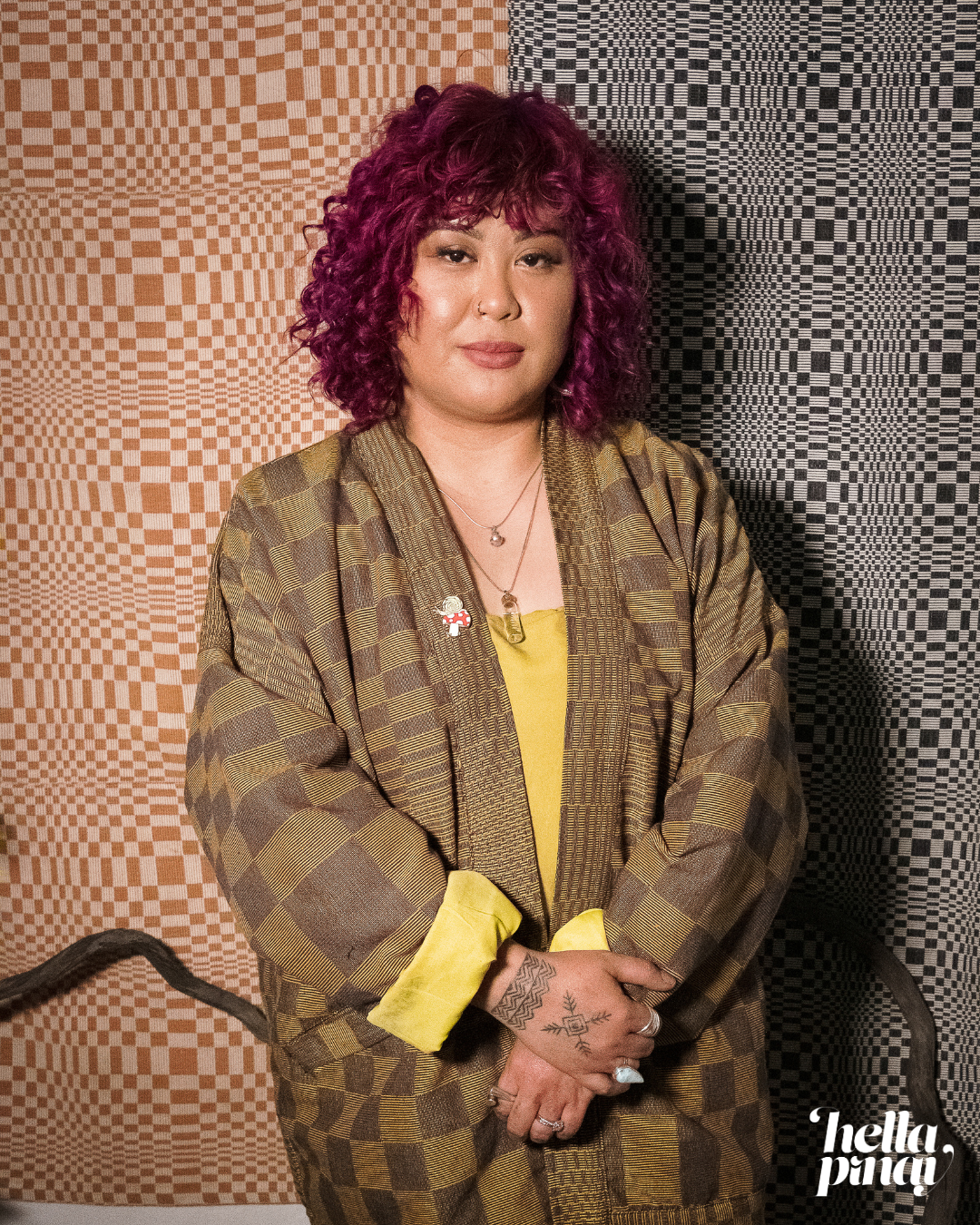
The author in the Hella Pinay studio with inabel textiles. Photography Kim Acebo Arteche.
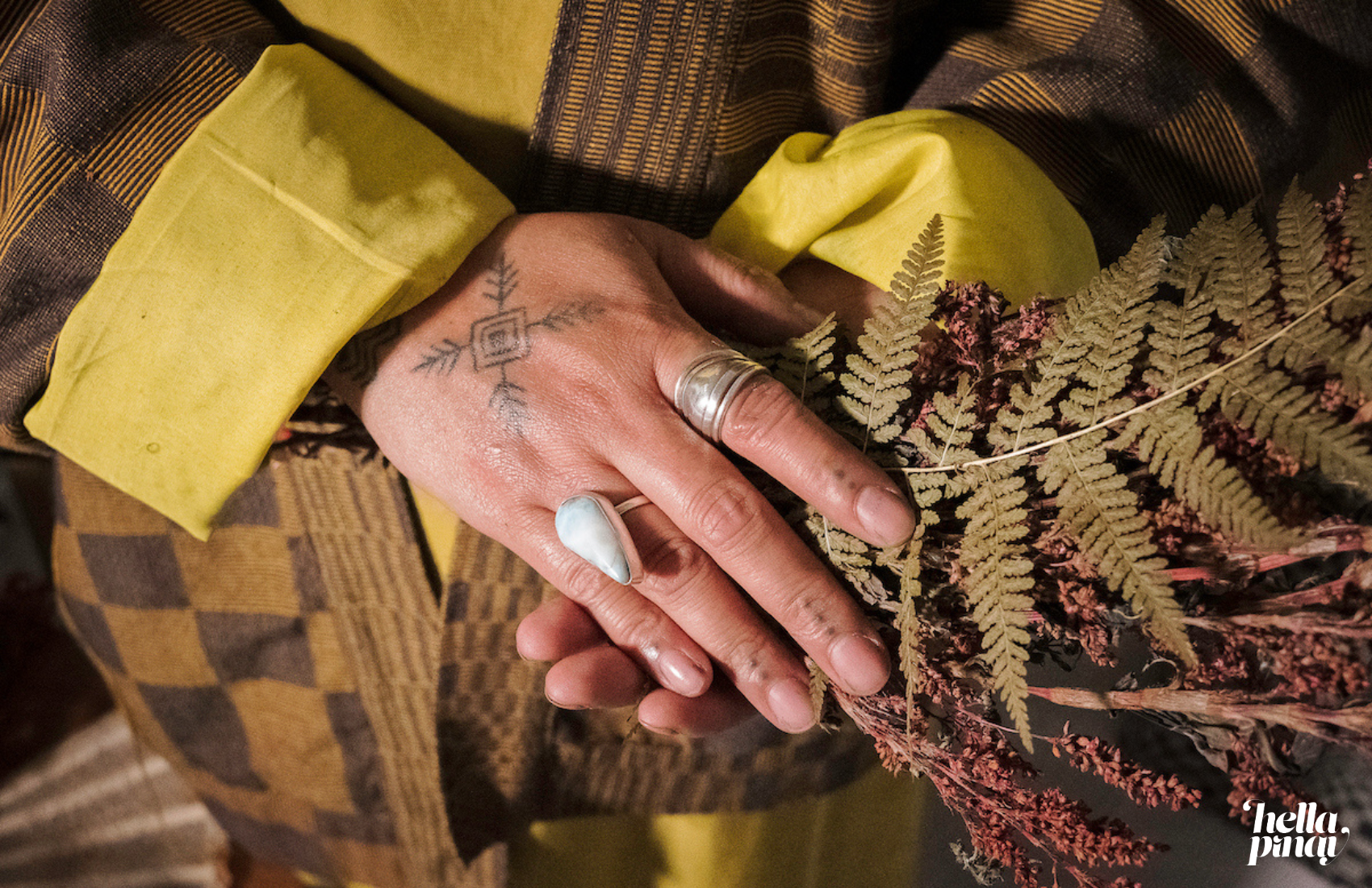
The author in the Hella Pinay studio with inabel textiles. Photography Kim Acebo Arteche.
HOW TO MAKE AN OIL INFUSION
Oil infusions are an easy and effective way to extract the beneficial properties from a plant.
Preparation
Fill a glass jar with dried plant material, then pour the oil of your choice over top. The oil will fill in all the gaps between the plant pieces, and you’ll notice some bubbling as the air escapes. Fill the jar completely and close the lid. (Do not screw the lid on too tightly as pressure may build up within the jar and cause it to crack.)
Quick Infusion
Place the jar into a pot of water, (a canning pot works perfectly for this,) and heat at medium on the stove for 3-4 hours. Make sure the water temperature does not exceed 110 degrees.
Slow Infusion
Let jar sit in a sunny location for 3-4 weeks.
Helpful Links for education and supplies:
https://www.frontiercoop.com
https://brambleberry.com
https://pipingrock.com
From Hella Pinay 03: The Culture Issue - Spring/Summer 2022.


Growing up Pinay, self-love and acceptance are ever growing and transforming